
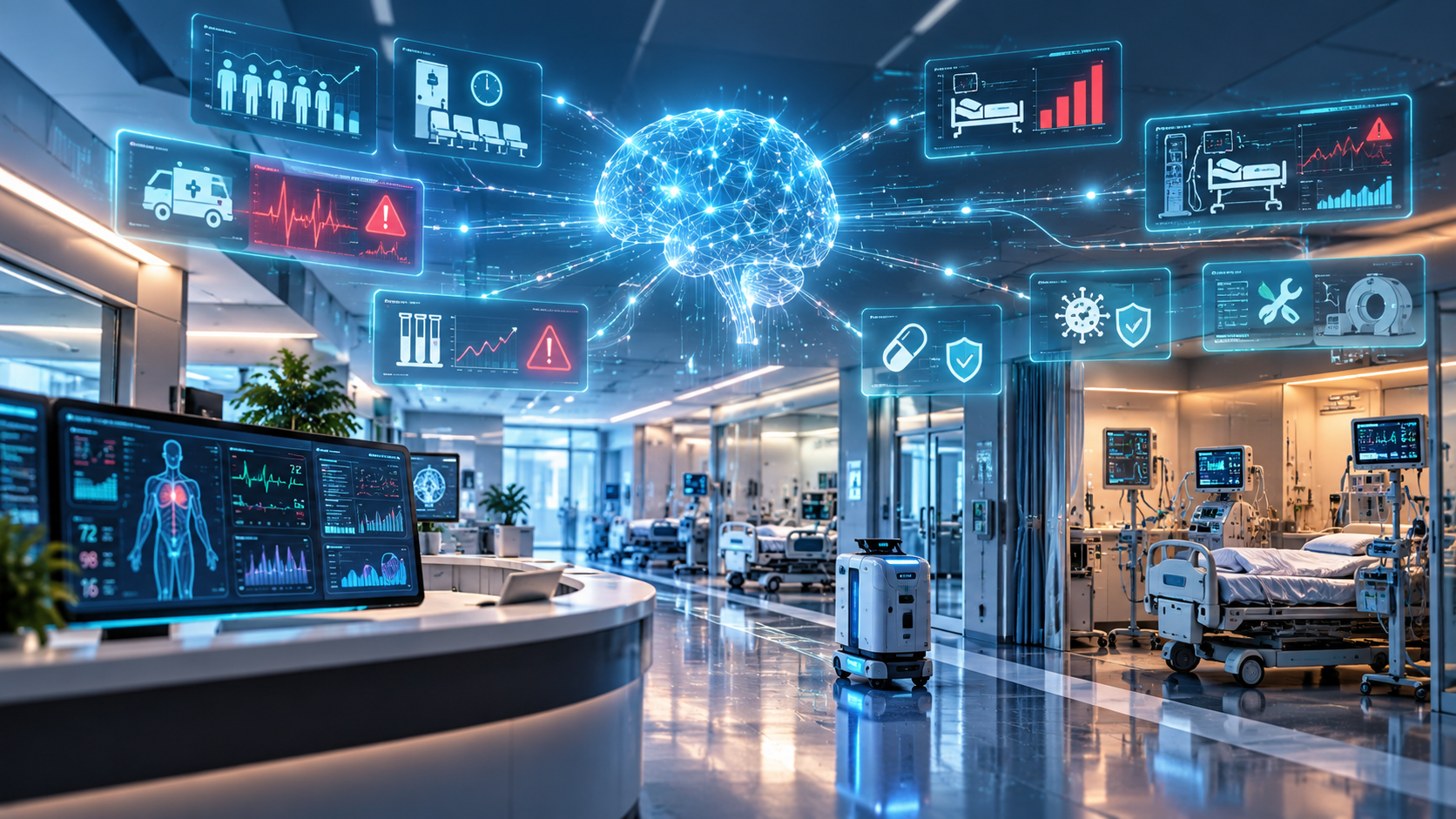
Imagine walking into a hospital. At the entrance, you are welcomed not only by a receptionist, but also by an invisible digital mind.
It knows which outpatient clinic is crowded, calculates the risk levels of patients waiting in the emergency department, monitors bed occupancy rates, detects critical deviations in laboratory results, and flags patients in intensive care who are at risk of deterioration before it happens.
It even keeps track of many details, from the building’s ventilation system to the maintenance schedules of medical devices.
This picture is no longer science fiction; it is what the age of artificial intelligence is bringing to healthcare...
The Transformation from Diagnosis to Hospital Management
Artificial intelligence first entered healthcare through diagnostic and imaging technologies. Systems capable of interpreting radiological images, calculating disease risks, and supporting clinical decisions attracted considerable attention.
Today, however, the issue is much broader. Artificial intelligence is far more than a tool that assists physicians; it has become a strategic force that is changing how hospitals are managed, how healthcare professionals are supported, how resources are used, and how services are planned.
Digital Hospitals That Learn from Data
The hospital of the future will not consist only of walls, wards, laboratories, and operating rooms. It will be a digital ecosystem that generates data, learns from data, anticipates risks, and accelerates decision-making processes.
Patient flow management, appointment scheduling, bed utilization, medication safety, infection control, staffing needs, energy consumption, and medical device maintenance will all become parts of the same intelligent network.
As a result, managers will make decisions not by looking at reports from the previous month, but by using systems that can anticipate the future through real-time data.
Saving Time in Healthcare Means Saving Lives
The greatest advantage of this transformation is speed. Today, many decisions in healthcare institutions are made with incomplete information, delayed reports, and under intense workload pressure.
Artificial intelligence, on the other hand, can analyze vast amounts of data within seconds and provide managers, physicians, and healthcare professionals with faster decision support.
Which department will become overcrowded? Which patient has a high risk of readmission? In which region are there signs of an outbreak? Which device should be serviced before it fails? Answering these questions earlier saves time in healthcare, and time directly saves lives.
Not Instead of Healthcare Professionals, but Alongside Them
Artificial intelligence also promises significant advantages for healthcare staff.
Repetitive documentation tasks, reporting burdens, patient classification, risk assessment, and routine monitoring processes can all be supported by intelligent systems. This allows physicians, nurses, and managers to devote their energy to more meaningful human decisions.
However, there is a critical boundary here: Artificial intelligence should be effective not by replacing healthcare professionals, but by complementing their judgment, attention, and decision-making capacity.
The best future scenario is not a healthcare system in which humans are excluded, but one in which artificial intelligence works to support people.
Seeing Errors Before They Occur
Patient safety lies at the heart of this transformation.
Traditional risk management often comes into play after an error has already occurred. Artificial intelligence, however, can help identify potential errors before they happen.
Drug interactions, fall risks, infection risks, the likelihood of deterioration in intensive care, or the probability of readmission after discharge can all be predicted in advance.
In this way, healthcare institutions can evolve from organizations that merely “find who made the error” into systems that can “foresee the error before it happens.”
The Dark Side of Intelligent Systems
Yet this promising future is not without shadows or problems.
Ultimately, artificial intelligence is a tool, an algorithm; if it is trained on flawed data, it can produce flawed decisions.
Data that fail to adequately represent certain patient groups may lead to algorithmic discrimination.
If sensitive health data are not properly protected, human dignity and patient trust may be harmed.
Continuous digital monitoring may also create new forms of performance pressure and technostress for healthcare professionals.
Who will trust an AI recommendation? Who will challenge it? Who will be responsible if an error occurs? Without answers to these questions, it is impossible to speak of a truly safe era of artificial intelligence in healthcare.
Combining Technology with Conscience
For this reason, the hospital of the future should not be merely “smart”; it should also be designed and professionally managed to be ethical, fair, transparent, and human-centered.
Every person in need of healthcare also needs to see a compassionate and caring human being in front of them.
For disadvantaged groups, especially older adults who may have difficulties using technology, this human compassion is even more essential.
Having the most advanced algorithm does not automatically make a hospital a good hospital. A good hospital is one that can combine data with wisdom, technology with conscience, speed with safety, and automation with the human touch.
The Healthcare Manager of the New Era
The role of the healthcare manager has also evolved. A manager is no longer simply someone concerned with budgets, staffing, and regulations.
A healthcare manager today must be capable of simultaneously managing data governance, AI ethics, employees’ digital competencies, patient privacy, cybersecurity, and the balance between humans and technology.
The healthcare managers and leaders of the new era must be those who can balance the power of algorithms with a humane understanding of healthcare.
The Real Question: How Will We Govern Artificial Intelligence?
Ultimately, the question is not, “Will artificial intelligence be used in healthcare?” It is already being used, and it will be used even more extensively.
The real question is: For whose benefit will we use artificial intelligence, within which ethical boundaries, under what governance model, and where will we place the human being within this system?
The Hospital of the Future Has Arrived
The hospital of the future has arrived. But whether it will bring healing to humanity or create new vulnerabilities will depend less on the technology itself than on how we choose to govern it.
References
Ağalday, Z., & Ağalday, B. (2025). Artificial intelligence in healthcare management: Leadership transformation and strategic directions / Sağlık yönetiminde yapay zekâ: Liderlik dönüşümü ve stratejik yönelimler. Artuklu Health, 13, 66–72. https://doi.org/10.58252/artukluhealth.1756166
Agarwal, R., Dugas, M., & Gao, G. G. (2024). Augmenting physicians with artificial intelligence to transform healthcare: Challenges and opportunities. Journal of Economics & Management Strategy, 33(2), 360–374. https://doi.org/10.1111/jems.12555
Akalın, B., & Veranyurt, Ü. (2020). Sağlıkta dijitalleşme ve yapay zekâ. SDÜ Sağlık Yönetimi Dergisi, 2(2), 128–137.
Alnasser, B. (2026). Impact of AI-based operational systems on employee performance in healthcare. Journal of Pioneering Medical Sciences, 15(3), 31–36. https://doi.org/10.47310/jpms2026150305
Araújo, A. S. de, & Campos, R. F. de. (2025). Regulations for the ethical and safe use of artificial intelligence in healthcare. Revista de Direito Sanitário / Journal of Health Law, 25(1), e0005. https://doi.org/10.11606/issn.2316-9044.rdisan.2025.232489
Bizalwan, D. S., Kumar, R., Kumar, A., & Gong, Y. Y. (2025). Enhancing healthcare with artificial intelligence: A configurational integration of complementary technologies and stakeholder needs. Communications of the Association for Information Systems, 57, 384–417. https://doi.org/10.17705/1CAIS.05715
Chow, W., Venkataraman, N., Oh, H. C., Ramanathan, S., Sridharan, S., Arish, S. M., Wong, K. C., Hay, K. K. X., Hoo, J. F., Tan, W. H. L., & Liew, C. J. Y. (2025). Building an artificial intelligence and digital ecosystem: A smart hospital’s data-driven path to healthcare excellence. Singapore Medical Journal, 66(Suppl. 1), S75–S83. https://doi.org/10.4103/singaporemedj.SMJ-2025-066
Ferrara, M., Bertozzi, G., Di Fazio, N., Aquila, I., Di Fazio, A., Maiese, A., Volonnino, G., Frati, P., & La Russa, R. (2024). Risk management and patient safety in the artificial intelligence era: A systematic review. Healthcare, 12(5), Article 549. https://doi.org/10.3390/healthcare12050549
Iordache, R. M., Cioca, V. R., & Mihaila, D. (2025). Digitalization in the world of work—Benefits and new risks for employees’ mental health. Polish Journal of Management Studies, 32(2), 111–124. https://doi.org/10.17512/pjms.2025.32.2.07
Kitsios, F., Kamariotou, M., Syngelakis, A. I., & Talias, M. A. (2023). Recent advances of artificial intelligence in healthcare: A systematic literature review. Applied Sciences, 13(13), Article 7479. https://doi.org/10.3390/app13137479
Manavgat, G. (2026). Yapay zekâ destekli sağlık hizmetleri sunumu: Fırsatlar, zorluklar ve stratejik yönelimler / Artificial intelligence-driven healthcare delivery: Opportunities, challenges, and strategic pathways. Ankara Sağlık Hizmetleri Dergisi, 23(1), 1–11.
Sampaio, R. P., Costa, A. A., & Flores-Colen, I. (2023). A discussion of digital transition impact on facility management of hospital buildings. Facilities, 41(5/6), 389–406. https://doi.org/10.1108/F-07-2022-0092
Sodhi, S. K., Bansal, S., Saxena, U., & Bhandari, R. S. (2025). Impact of artificial intelligence on Indian health care systems. International Journal of System Assurance Engineering and Management. https://doi.org/10.1007/s13198-025-03091-x