
The Living Urban Image Through Senses, Emotions, and Narratives
What is the first thing you notice when walking through a city? The sounds of a lively square, the aroma of freshly baked bread drifting from a neighborhood bakery, or the cool sensation of touching an old stone wall? Every day, we experience cities not only with our eyes but also through all five senses and our emotions. Whether we consciously realize it or not, our brains continuously record these experiences.
The ways in which people perceive and describe the places they encounter remind us of a simple yet often overlooked truth: cities are not merely places to be seen. They are living environments that are heard, smelled, tasted, touched, felt, and emotionally experienced.
“The sound of car horns greets us as we enter the area. The clinking of keys, the jingling of loose coins, and the rhythmic footsteps of children running across the pavement blend into a vibrant urban soundscape...” Intersection of Kunduracılar Street and Gazi Paşa Street
When we think about cities, we often picture maps, buildings, public squares, or iconic landmarks. Yet what truly gives a city its meaning is the countless encounters people experience within these spaces. The sound of the wind moving through narrow streets, the aromas drifting from traditional marketplaces, the cool texture of ancient stone walls, the joy or melancholy evoked by a particular place, or even the rhythm of a bustling crowd—all of these sensory and emotional encounters shape the invisible dimensions of urban experience.
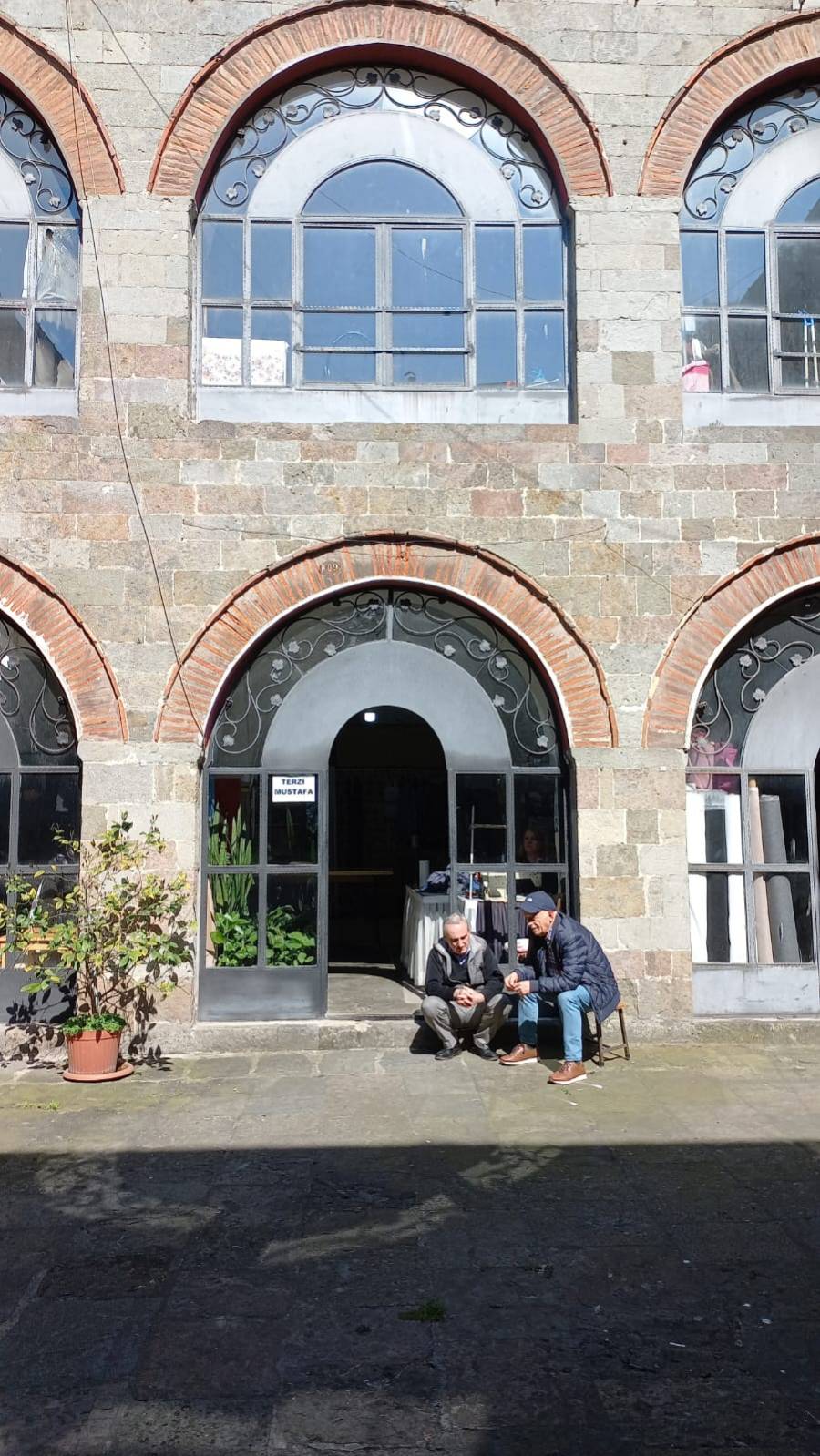
“The rough texture of the stones beneath your feet suddenly transports you back in time...” Taşhan
This is precisely where architectural experience emerges. Through lived experience, the city becomes a dynamic environment in which the senses and emotions intertwine. The character of a city is expressed not only through its architecture but also through the encounters, memories, impressions, and personal meanings that people associate with its places. Understanding a city therefore requires more than observing its physical form; it also demands the ability to recognize and interpret its invisible sensory and emotional dimensions.
For many years, studies of urban experience focused primarily on the physical characteristics of cities. Street layouts, building locations, public squares, and urban skylines were regarded as the principal elements shaping urban perception. Research on the image of the city largely emphasized these visual and spatial representations. However, the experience of a city extends far beyond what can be seen.
In recent years, architecture and urban studies have increasingly explored how sensory and emotional experiences influence the perception of urban environments. Phenomenology—a philosophical approach that examines how people experience the world through the body and lived experience—argues that space is not simply an object perceived by the eyes but a phenomenon experienced through the entire body. This multisensory relationship plays a fundamental role in the formation of urban memory and in developing a sense of belonging between people and places.
But how can these invisible sensory and emotional dimensions of cities be identified, interpreted, and systematically documented?
The UNARCODE Approach
One initiative that seeks to answer this question is the UNARCODE approach. Derived from the term Urban Narrative Codes, the
UNARCODE© application aims to transform urban experience from a purely observed phenomenon into an interactive and traceable digital platform for city users. By documenting the sensory, emotional, and narrative dimensions of urban life, the platform makes the city's living memory visible and accessible.
Cities are shaped not only by their historical buildings but also by the images, stories, and memories accumulated in the minds of their inhabitants. A city's memory is therefore not preserved solely in archives or architectural monuments; rather, it resides in the narratives, encounters, and everyday experiences that unfold within urban life.
Focusing on the relationship between people, place, and space, the UNARCODE approach conceptualizes the city as a living, continuously evolving organism. By systematically documenting urban experiences, it enables the city's collective memory to become traceable, shareable, and accessible through digital technologies.
“Rows of dried eggplants hanging beside colorful spices resemble shelves filled with memories. Each scent settles upon me like another layer drifting from the past...” Bedesten
The Case of Trabzon
The city of Trabzon provides one of the most significant case studies demonstrating the application of this approach. Historically, Trabzon was one of the major Anatolian gateways along the Silk Road. Field studies were conducted along an experiential route extending from Meydan Park through Kunduracılar Street, Semerciler Slope, and finally to the Bedesten marketplace.
Narratives, sensory observations, emotional responses, and architectural sketches collected along this route revealed the city's spatial experience from multiple perspectives.
Over approximately one year of fieldwork, the relationships established between users—primarily undergraduate architecture students—and urban spaces were investigated using qualitative research methods. Participants' experiences were documented through spoken narratives, written reflections, sketches, and visual representations. These qualitative records were subsequently digitized and transformed into analyzable datasets.
The resulting data were integrated into the UNARCODE© application, making them digitally accessible and allowing the creation of interactive maps representing Trabzon's urban memory. By bringing together sensory impressions, emotional responses, and personal narratives, these maps provide a multidimensional interpretation of the city's experiential landscape.
One of the most distinctive strengths of the UNARCODE© platform is its flexible infrastructure, which enables adaptation to different cities both nationally and internationally. In this context, the international research project "Investigating the Living Urban Image through Urban Narrative Codes (UNARCODE©)", supported for two years under the TÜBİTAK 2515 COST Action Members R&D Support Program, has made a significant contribution to developing the extensive dataset required for the application.
Rather than merely documenting the past, the UNARCODE approach contributes to the creation of a living urban memory by recording the experiences of city users and preserving them for future generations. The journey that began in Trabzon establishes a valuable methodological foundation for similar research to be conducted in cities around the world.
Conclusion
The UNARCODE approach does more than document the historical fabric of cities; it captures the lived experiences of their users, contributing to the creation of a dynamic urban memory that can be preserved and shared with future generations. By integrating sensory perceptions, emotional responses, and personal narratives into a digital platform, it offers a richer and more human-centered understanding of urban environments.
The experiential journey that began in Trabzon also provides a valuable methodological framework for future research in other cities. Because every city possesses its own unique sensory landscape, emotional atmosphere, and collective memory, documenting these experiences can contribute not only to urban studies but also to architecture, heritage conservation, urban planning, and digital humanities.
Ultimately, truly understanding a city is not achieved merely by examining its streets, buildings, or landmarks. It requires reading the countless experiences accumulated within those spaces—the sounds that echo through its streets, the scents that evoke forgotten memories, the textures that connect us with history, and the emotions that transform ordinary places into meaningful ones.
Only by recognizing these invisible layers can we begin to understand the living image of a city.
Acknowledgements
This study was supported by the Scientific and Technological Research Council of Türkiye (TÜBİTAK) under Project No. 223K212. The author gratefully acknowledges TÜBİTAK for its financial support.
References
Durmuş Öztürk, S. Narrating Architectural and Urban Ambiances: The Living Urban Image through the UNARCODE Project. CitySenZ Conference Series, CA23145 (2025), 80–85.
Durmuş Öztürk, S., & Çıraklı, M. Z. The City as a Narrative Space and the Experience of Place. Nalans Conference Proceedings (2023), 295–304.
Lynch, K. The Image of the City. MIT Press, 1960.
Merleau-Ponty, M. Phenomenology of Perception. Routledge, 1962.
Pallasmaa, J. The Eyes of the Skin: Architecture and the Senses. Wiley, 2012.