
Some of the most important medicines in modern healthcare owe their origins to snake venom, the saliva of a leech, or the tissues of marine organisms. Although this may sound unsettling at first, it highlights one of nature's greatest strengths: its extraordinary capacity to provide molecules that can improve human health. Many medicines used today were inspired by compounds that animals naturally produce.
The use of animals for medicinal purposes is far from a new concept. Throughout history, cultures around the world have relied on animal-derived substances to treat a wide range of illnesses. This practice is known as zootherapy, which refers to the therapeutic use of animal tissues, secretions, or metabolic products in the prevention and treatment of disease.
Molecules from Animals
Although many modern medicines originate from plants, animals have also played a crucial role in drug discovery. Approximately 9% of the essential medicines identified by the World Health Organization have been developed from animal-derived compounds. Some of these molecules are used directly as therapeutic agents, while others have served as blueprints for the development of entirely new drugs.
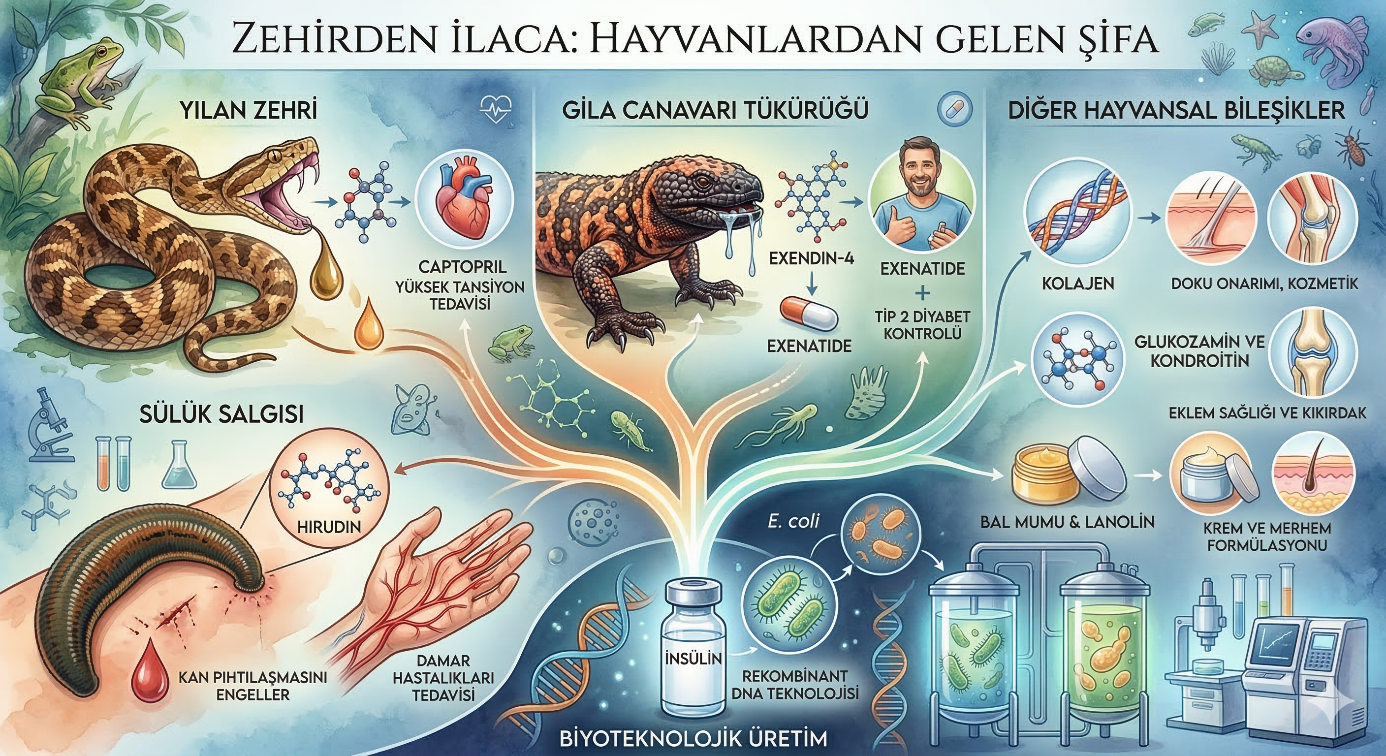
One of the earliest and most fascinating examples comes from the medicinal leech. During the Middle Ages, leeches were widely used to remove what was believed to be "excess blood" from the body. Although physicians at the time had no scientific understanding of why the treatment sometimes worked, we now know that leech saliva contains a powerful anticoagulant molecule called hirudin.
Hirudin inhibits thrombin, a key enzyme responsible for blood clotting, thereby preventing the formation of blood clots. Today, recombinant forms of hirudin are used in the treatment of various cardiovascular and thrombotic disorders. Thus, a therapy once rooted in traditional medicine has inspired one of modern pharmacology's important therapeutic agents.
Medicines Inspired by Venom
One of the most remarkable examples of animal-derived medicines originates from snake venom. Snake venoms contain hundreds of biologically active proteins and peptides, many of which exert profound effects on the human cardiovascular and coagulation systems.
In the 1970s, researchers began investigating compounds isolated from the venom of Bothrops jararaca, a pit viper native to South America. Their work ultimately led to the development of captopril, one of the first angiotensin-converting enzyme (ACE) inhibitors used to treat hypertension. Today, millions of people worldwide benefit from blood pressure medications that were inspired by this groundbreaking discovery.
Another striking example comes from the Gila monster, a venomous lizard native to North America. Scientists discovered that its saliva contains a peptide called exendin-4, which mimics the activity of hormones that stimulate insulin secretion. This discovery led to the development of exenatide, a medication widely used in the treatment of type 2 diabetes. Today, exenatide remains an important therapeutic option for improving blood glucose control in patients with this disease.
Everyday Medical Applications
Animal-derived substances are not limited to remarkable stories of scientific discovery. In fact, many medical products we use in everyday clinical practice contain compounds of animal origin.
One of the best-known examples is collagen, the most abundant protein in the human body and the primary structural component of connective tissues. Collagen provides strength and integrity to the skin, bones, tendons, ligaments, and blood vessel walls. Owing to its excellent biocompatibility, it is widely used in wound dressings, tissue engineering, regenerative medicine, and plastic and reconstructive surgery. Because of its ability to improve skin hydration and elasticity, collagen is also a key ingredient in numerous cosmetic products.
Similarly, glucosamine and chondroitin are commonly found in dietary supplements formulated to support joint health. These naturally occurring compounds contribute to the synthesis and maintenance of cartilage, helping preserve the structural integrity of joints. Consequently, they are widely incorporated into supportive therapies for degenerative joint disorders such as osteoarthritis.
The use of animal-derived materials extends beyond active pharmaceutical ingredients. Natural substances such as beeswax and lanolin are frequently employed as pharmaceutical excipients in creams, ointments, and cosmetic formulations. Beeswax forms a protective barrier on the skin, prolonging the residence time of topical medications while helping to reduce moisture loss. Lanolin, obtained from sheep's wool, is valued for its exceptional moisturizing properties and plays an important role in many skin-care products. In addition, these materials help optimize the consistency, stability, and controlled release of active ingredients, thereby enhancing the overall performance of pharmaceutical formulations.
Transformation Through Biotechnology
Until relatively recently, many of these biologically active molecules were extracted directly from animal tissues. For decades, this approach served as the primary source for producing numerous medicines. However, obtaining compounds from animal tissues presented several challenges, including limited availability, labor-intensive purification processes, and concerns regarding long-term sustainability, consistency, and biological safety.
Advances in biotechnology have fundamentally transformed this field. Today, many biologically important molecules can be produced using recombinant DNA technology. In this approach, the genetic information responsible for producing a desired molecule is introduced into rapidly growing microorganisms, such as bacteria or yeast. These organisms effectively function as miniature biological factories, producing large quantities of the target protein under carefully controlled laboratory conditions.
One of the best-known examples of this transformation is insulin. For many years, insulin used to treat diabetes was extracted from the pancreases of pigs and cattle. Today, however, it is produced almost exclusively through genetic engineering using bacteria or yeast cells. This biotechnology-based approach provides insulin that is purer, safer, and more consistent than animal-derived preparations.
The impact of recombinant technology extends far beyond insulin. Numerous hormones, enzymes, antibodies, and other therapeutic proteins are now manufactured using similar methods. As a result, pharmaceutical production has become more scalable, reliable, and sustainable, while improving patients' access to life-saving medicines worldwide.
Conclusion: Nature as the World's Largest Pharmacy
Living organisms have evolved an extraordinary diversity of chemical compounds that enable them to survive, defend themselves, communicate, and adapt to their environments. While these molecules serve biological functions in nature, they also represent an invaluable resource for biomedical research. For scientists, each newly discovered compound is a potential starting point for the development of tomorrow's medicines.
Perhaps the next breakthrough antibiotic lies hidden within the skin of a frog. Perhaps a marine organism harbors a compound capable of treating cancer, or an insect secretion contains the key to combating a disease that has long challenged modern medicine. These possibilities remind us that nature remains one of humanity's greatest reservoirs of therapeutic innovation.
Despite remarkable advances in synthetic chemistry and biotechnology, nature continues to inspire many of the medicines that transform modern healthcare. Rather than replacing nature, scientific progress increasingly seeks to understand, refine, and harness its remarkable chemical diversity.
Nature is, in many ways, the world's largest pharmacy—one whose shelves remain only partially explored. Every new discovery not only deepens our understanding of biology but also brings us one step closer to safer, more effective, and more innovative treatments for the future.
Image: Generated using Gemini AI.
References
G. Renda, Phytochem Rev, 24 (2025) 3523–3548.
E.M. Costa-Neto, Anais da Academia Brasileira de Ciencias, 77 (2005) 33–43.
A.C. Duarte, et al., Biomater Adv, 151 (2023) 213428.