
Why do we trust the mobile applications we use every day? Decades of research in the field of Management Information Systems (MIS) suggest that the answer lies not only in technology itself, but also in human psychology, perceived usefulness, and the sense of trust that shapes our willingness to embrace digital innovations.
How Do We Decide Whether to Trust an App?
Think back to the moment you first opened a shopping app you had just downloaded. You add an item to your cart, prepare to enter your credit card information, and suddenly hesitate for a brief moment:
"Can I really trust this app?"
Although this question seems perfectly ordinary, it has been one of the central topics of scientific inquiry for decades.
How Does Management Information Systems Approach This Question?
Despite its technical name, Management Information Systems (MIS) is fundamentally concerned with something deeply human: the interaction between technology and human behavior.
For years, researchers in this field have explored a simple but profound question: Why do people embrace new technologies—or reject them?
A recent bibliometric study sought to answer this question by examining the 500 most-cited articles in the history of the MIS discipline. Bibliometric analysis is a research method that maps scientific knowledge by analyzing patterns such as citations, authorship, and keywords rather than reading every publication individually. A citation simply indicates how many times a scientific paper has been referenced by later studies—something like the academic equivalent of a "like," although with far greater scholarly significance.
Why Do We Adopt New Technologies?
Perhaps the most striking finding of the study was that, despite covering different topics, the vast majority of these highly influential papers revolved around the same fundamental question:
Why do people adopt new technologies?
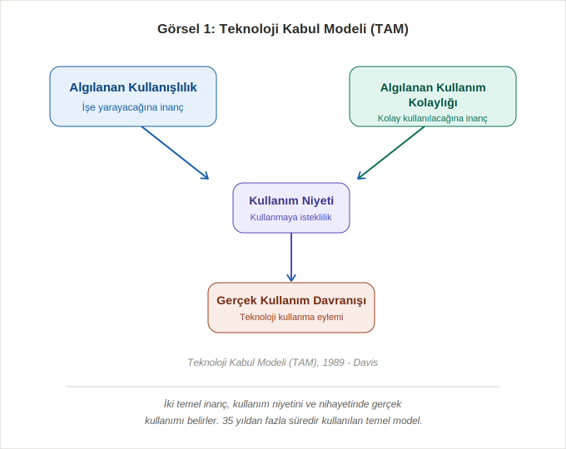
The best-known answer was proposed in 1989 with the introduction of the Technology Acceptance Model (TAM).
The model is surprisingly simple. It argues that two perceptions largely determine whether people decide to use a new technology:
- Perceived usefulness—the belief that the technology will improve one's performance or make life easier.
- Perceived ease of use—the expectation that using the technology will require little effort.
In other words, if people believe an application will genuinely benefit them and can be used without frustration or confusion, they are highly likely to adopt it.
This seemingly straightforward idea became one of the most influential theories in the history of information systems research. Among the 500 articles analyzed, the original Technology Acceptance Model paper ranked first by a wide margin, accumulating nearly 39,000 citations—an extraordinary figure by academic standards.
Why Does the Model Still Matter Today?
What makes the Technology Acceptance Model particularly remarkable is its longevity.
More than thirty-five years after its introduction, it continues to guide research despite having been developed long before smartphones, social media, cloud computing, or artificial intelligence became part of everyday life.
Its enduring success lies in its simplicity. Because the model is both intuitive and adaptable, researchers have successfully applied it to countless technologies—from mobile commerce and online banking to e-learning platforms, wearable devices, and AI-powered applications.
Few scientific theories remain relevant across so many generations of technological change, yet the Technology Acceptance Model continues to serve as one of the field's most influential conceptual frameworks.
Trust: The Invisible Currency of the Digital World
The story, however, does not end with usefulness and ease of use.
Another concept appears repeatedly throughout the Management Information Systems literature: trust.
Particularly in online shopping, a user's decision to enter credit card information often depends less on technical specifications than on a simple psychological feeling—whether the application seems trustworthy.
That brief hesitation you experienced before completing an online purchase is precisely the phenomenon researchers have been investigating for decades.
Numerous studies demonstrate that trust functions as an invisible currency in the digital world. It cannot be downloaded, programmed, or installed, yet it fundamentally shapes users' willingness to adopt digital services. Even the most sophisticated application may fail if users do not trust it, whereas a well-designed platform that inspires confidence is far more likely to gain widespread acceptance.
How Has Research Evolved Over Time?
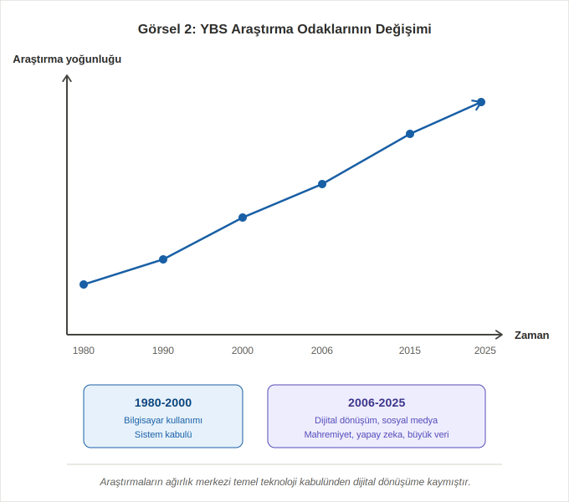
The bibliometric analysis also reveals how the field of Management Information Systems has evolved over the past four decades.
During the 1980s and much of the 1990s, researchers were primarily concerned with a straightforward question:
How do people use computers?
As digital technologies became integrated into everyday life, however, the focus of research gradually shifted.
From around 2006 onward, new themes began to dominate the literature, including social media, digital transformation, online privacy, cybersecurity, big data, mobile technologies, and artificial intelligence.
This evolution mirrors society's changing relationship with technology itself.
A generation ago, discussions centered on how long people spent using computers. Today, we are increasingly concerned with questions such as:
- Who owns our data?
- Which applications are collecting our personal information?
- How do recommendation algorithms influence our decisions?
- Can artificial intelligence be trusted?
These questions illustrate how our relationship with technology has become not only more sophisticated but also more deeply intertwined with issues of ethics, privacy, and governance.
What Do These Findings Mean for Us?
The implications extend far beyond academic research.
For business leaders and digital service providers, the message is clear: developing powerful technology is no longer enough. Digital
products must also be intuitive, easy to use, and, above all, trustworthy.
Technical excellence alone does not guarantee adoption. Users embrace technologies that reduce uncertainty, inspire confidence, and create positive experiences.
For consumers, these findings offer a different perspective. That instinctive feeling of trust—or distrust—you experience when downloading an application, making an online payment, or granting permissions is not simply intuition. It reflects psychological mechanisms that researchers have spent decades studying and refining through empirical evidence.
Understanding these mechanisms enables us to become more informed and more critical users of digital technologies.
Trust in the Age of Artificial Intelligence
As artificial intelligence, blockchain technologies, and algorithmic decision-making become increasingly integrated into everyday life, it is becoming clear that traditional models alone may no longer be sufficient to explain how people adopt emerging technologies.
Tomorrow's users may face questions far more complex than whether to trust an online shopping application. Instead, they may find themselves asking:
Can I trust an artificial intelligence to make decisions on my behalf?
Can an AI system provide reliable medical advice? Should autonomous vehicles make life-and-death decisions? Can algorithms be trusted to evaluate job applications, approve loans, or determine legal outcomes fairly?
These questions suggest that trust will become one of the defining challenges of the AI era. Future research in Management Information Systems will therefore need to move beyond usability and usefulness, incorporating new concepts such as algorithmic transparency, explainability, fairness, accountability, and ethical AI.
In many ways, the next generation of technology acceptance models may be less about how technology works and more about whether people believe it deserves their trust.
Conclusion
The next time you download a new application and tap the "I Agree" button, pause for a moment.
That brief hesitation before granting permissions, sharing personal information, or entering your payment details may seem insignificant, but it reflects one of the most enduring questions in the field of Management Information Systems.
Every click, every decision to trust—or not to trust—a digital technology represents the intersection of technology, psychology, and human behavior.
Understanding why we trust technology ultimately helps us design digital systems that are not only smarter, but also safer, more transparent, and more worthy of the confidence we place in them.
In an increasingly digital world, trust may prove to be the most valuable technology of all.
References
Ayaz, A. (2026). The 500 Most-Cited Articles in Management Information Systems: A Bibliometric and Thematic Approach. Information Systems Frontiers, 28(1), 317–340.
Davis, F. D. (1989). Perceived usefulness, perceived ease of use, and user acceptance of information technology. MIS Quarterly, 13(3), 319–340.
Davis, F. D., Bagozzi, R. P., & Warshaw, P. R. (1989). User acceptance of computer technology: A comparison of two theoretical models. Management Science, 35(8), 982–1003.
Ergüner Özkoç, E. (2019). A Bibliometric Structure and Social Network Analysis of Management Information Systems Research in Türkiye. Journal of Social Sciences, 12(1), 25–43.
Gedik, H. (2023). The Relationships Between Perceived Website Quality, Trust, and Online Impulse Buying in E-Marketplaces. Anatolia Social Research Journal, 2(2), 29–47.
Legris, P., Ingham, J., & Collerette, P. (2003). Why do people use information technology? A critical review of the Technology Acceptance Model. Information & Management, 40(3), 191–204.
Venkatesh, V., & Davis, F. D. (2000). A theoretical extension of the Technology Acceptance Model: Four longitudinal field studies. Management Science, 46(2), 186–204.
Wu, K., Zhao, Y., Zhu, Q., Tan, X., & Zheng, H. (2011). A meta-analysis of the impact of trust on the Technology Acceptance Model: Investigating moderating mechanisms. International Journal of Information Management, 31(6), 572–581.