

Imagine asking ourselves a series of questions about crime. Are crimes occurring more often than ever before? Is crime a more widespread and frequent problem today than it was in the past? Or have crime-related issues simply become more visible? Is crime-related content among the things we encounter most often in the media? The answers to these questions can help us understand the place of crime in our everyday lives.
What Is Crime?
The meaning of crime varies depending on who defines it. Four broad perspectives can be distinguished in defining crime: legal, political, sociological, and psychological. From a legal perspective, for example, crime is a violation of criminal law. From a sociological perspective, crime is behaviour that disrupts the social order and warrants punishment. Robbery, assault, and murder are examples.
What Causes Crime?
Criminal behaviour has been a problem for societies throughout history. Societies seek to curb and prevent it, or at least to reduce its incidence. In seeking to address crime, modern societies have first examined its causes. Disciplines such as sociology, psychology, psychiatry, and criminology have all sought to explain it.
Two sociological perspectives on the causes of crime are the consensus and conflict perspectives. From a consensus perspective, crime can occur when individuals fail to follow shared social rules in their own lives. The looting of homes in the aftermath of the 2023 Kahramanmaraş earthquakes is one example. From a conflict perspective, crime can arise when advantages associated with education, occupation, and income translate into social power. The case referred to in the media as the “newborn gang” is one example.
Has Crime Increased?
There is a common perception that crime has increased. Establishing such a trend would require comprehensive data on crime rates over time, and such data are unavailable. Even with those data, however, interpreting the trend would require care. Advances in technology have made it easier to detect crimes and apprehend offenders. An increase in recorded cases may therefore reflect improved detection.
Has Crime Become a More Widespread and Frequent Problem?
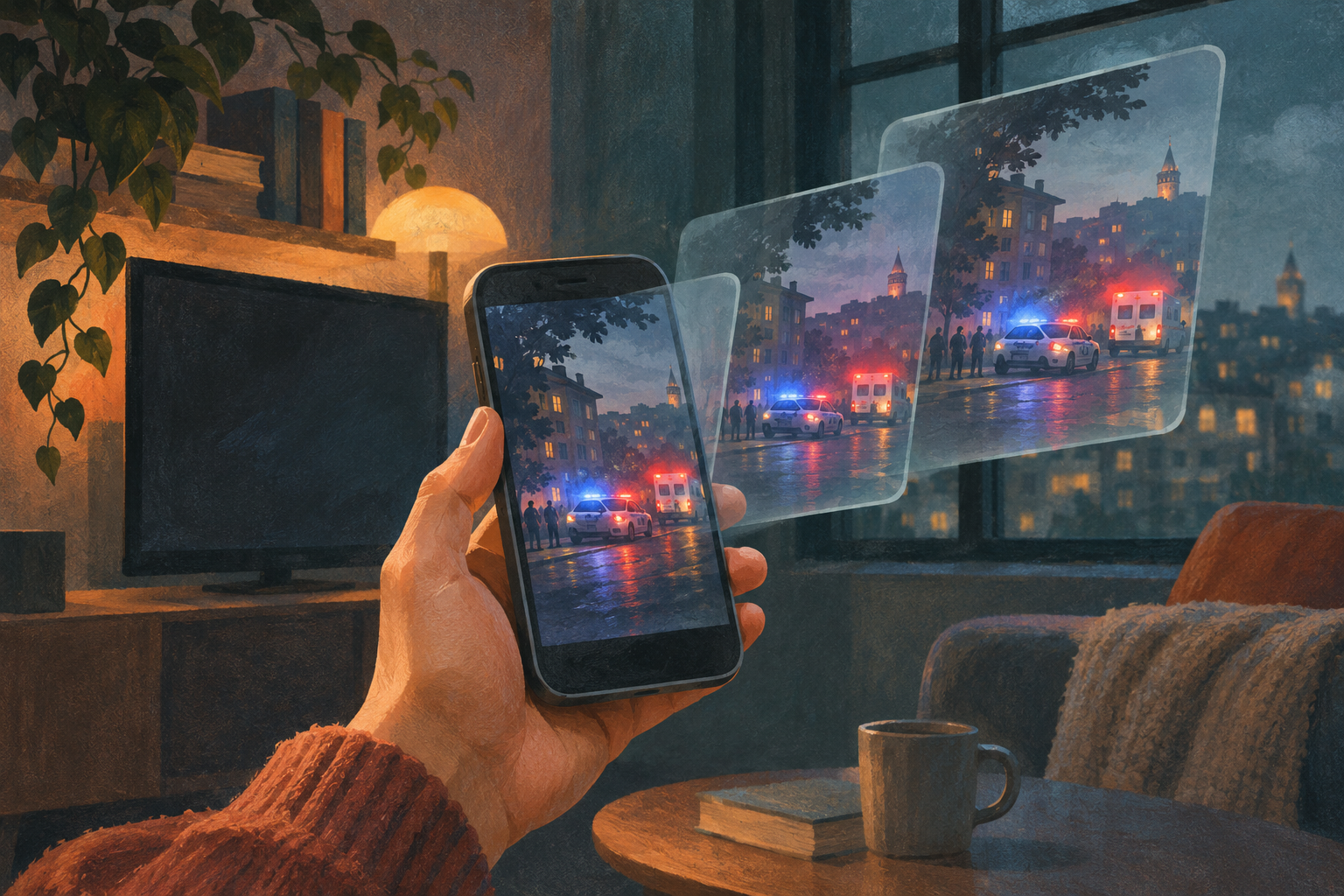
Even without firm evidence that crime has increased, it has become more visible. Communication technologies have played an important role in this shift. Crime news once reached audiences through television, newspapers, and radio. Since the 2000s, the internet has expanded its reach. Online platforms that almost anyone can access on a mobile phone have made it easier for crime-related content to circulate widely and become more visible.
According to a global study, 73.2% of the world’s population used the internet in 2025, and 68.7% used social media. In Türkiye, 93.3% of the population had access to mobile internet, while 70.9% used social media. Türkiye ranked 16th among all countries in internet use. Weekly social media use in Türkiye amounted to 41 hours and 37 minutes, well above the global average. In this context, crime stories can be considered among the most common types of news content. Some recent studies have also found an association between how often people use social media and their exposure to crime news. The available evidence leaves open whether crime has increased, while its growing visibility is apparent.

How Do the Media Present Crime-Related Content?
The way crime stories are presented matters as much as how frequently they appear. Media outlets frame these stories to inform audiences, attract wider attention, and encourage people to share them. Stanley Cohen’s theory of moral panic approaches the relationship between crime and the media from this perspective. In his study, Cohen discusses young people in England who identified with the rock music scene. He argues that the way an incident is presented can lead the public to perceive it as criminal even when the underlying conduct does not constitute a crime.
One striking example is football-related violence. In England in the 1980s, news coverage of football violence typically portrayed the perpetrators as young working-class men. Cohen’s account shows how the media can broaden public perceptions of crime through the stories they produce and the meanings they attach to them. A contemporary example can be found in coverage involving migrants. Emphasising that those involved in an assault or other violent incident are migrants can encourage audiences to generalise from an individual incident and view migrants as a group as aggressive or as a threat to public order.
Conclusion
We may go through our everyday lives without directly experiencing crime, yet stories on television, in newspapers, or on social media can bring other people’s experiences into our own lives. The idea that “once something appears in the media, it becomes everyone’s concern” suggests that experiences we encounter indirectly can affect us as deeply as those we have ourselves.
Does crime have to increase for people to see it as a problem? Research on the fear of crime helps address this question. In its simplest sense, fear of crime is the fear of becoming a victim of crime. Do crime rates have to be high for this fear to arise? Studies have found that people can report high levels of fear even in areas with low crime rates. The relationship between society, crime, and fear therefore extends beyond what crime rates alone can tell us.
References
Baki, B. U., & Boyacıoğlu, A. O. (2023). Yeni medyada suç haberleri ve gündelik hayatta dolaylı mağduriyet [Crime news in new media and indirect victimisation in everyday life]. Türkiye İletişim Araştırmaları Dergisi, (42), 63–83. https://doi.org/10.17829/turcom.1122390
Calton, S. L., Wilson, M., Zander, J. P., & Keatley, D. (2026). Crime-related content on Facebook and Twitter (X): Comparing comment sentiment between Australian news and police posts. Policing and Society, 36(4), 474–493.
Cohen, S. (2019). Halk düşmanları ve ahlaki panikler [Folk devils and moral panics]. Heretik Yayınları.
Dolu, O. (2015). Suç teorileri: Teori, araştırma ve uygulamada kriminoloji [Theories of crime: Criminology in theory, research, and practice]. Global Yayınları.
İçli, T. G. (2013). Kriminoloji [Criminology]. Seçkin Yayınları.
Loo, D. (2008). The ‘moral panic’ that wasn’t: The sixties crime issue in the US. In S. Farrall & M. Lee (Eds.), Fear of crime: Critical voices in an age of anxiety (pp. 12–31). Routledge-Cavendish.
We Are Social. (2026). Digital 2025: The essential guide to the global state of digital. https://wearesocial.com/uk/blog/2025/02/digital-2025-the-essential-guide-to-the-global-state-of-digital/